Whitepaper
From Storage Bins to Living Memory
The Case for the Organizational Memory Platform™
Paul Faustin, Founder & CEO, Gateway Architect, LLC. Version 1.4, July 2026.
Organizations forget faster than they capture what they learn. The Organizational Memory Platform is the category of enterprise software built to address this directly: capturing decisions, recording outcomes, and surfacing relevant context at the moment new decisions are required. Gateway Architect™ is the first platform built around the closed outcome loop.
Document changelog
Version 1.4 (July 2026): updated the developmental-ladder figure and analysis to reflect the shipment of v1.4 Associative Recall on July 2, 2026, which advances Gateway Architect from Stage 2 (Synaptic Structure) to Stage 3 (Associative Recall). Added the Architecture Context API and MCP integration, cross-project decision sharing and relationship scope, the organization decision graph, and outcome-weighted ranking. Documented the zero-trust visibility model and API-token security. Noted that outcome-weighted ranking has shipped while outcome-weighted retrieval remains Stage 4 roadmap.
Version 1.3 (June 2026): updated the developmental-ladder figure and the surrounding analysis to reflect the shipment of v1.3 Synaptic Structure on June 2, 2026, which advances Gateway Architect from Stage 1 (Encoding) to Stage 2 (Synaptic Structure).
Version 1.2 (May 2026): added a paragraph in Section 2.3 acknowledging Gary Marcus and Yann LeCun as the closest intellectual antecedents in the AI-cognition critique tradition, distinguishing the OMP’s organizational layer from their cognitive-systems layer.
1. Executive Summary
Enterprise software has spent three decades building tools for storing documents, tracking tasks, and answering questions from a corpus. It has not built a system of record for the reasoning behind organizational decisions, and it has not built a system that links those decisions to their implementation outcomes over time. This absence has a cost. Senior people leave with the context. New people repeat resolved problems. Auditors find decisions without rationale. Organizations relearn, every contract cycle, the lessons they have already paid for once.
In 1991, James Walsh and Gerardo Ungson published the foundational academic treatment of this phenomenon in Academy of Management Review. Arnold Kransdorff, in his 1998 book Corporate Amnesia, gave the failure mode its popular name. For thirty-five years it was a slow leak. The arrival of generative AI in production engineering environments has turned the leak into a flood, and the evidence is now available across three independent research firms and the US Bureau of Labor Statistics.
This document makes the case for a new category of enterprise software: the Organizational Memory Platform. The concept of organizational memory dates to Walsh and Ungson in 1991. The software category that productizes the concept, the Organizational Memory Platform, was named in May 2026. The category is defined by three properties that distinguish it from every adjacent option in the market (knowledge management, learning management, governance and compliance tooling, enterprise search, code-generation assistants, and general-purpose AI chat). The category develops through eight ordered stages with structural dependencies that cannot be skipped. The platform must operate under data isolation guarantees that respect the customer’s tenant boundary in regulated environments.
Gateway Architect is the first platform built around the closed outcome loop, applied to software architecture. It shipped v1.2 Closed Loop GA (Stage 1, Encoding) on May 18, 2026, v1.3 Synaptic Structure (Stage 2) on June 2, 2026, and v1.4 Associative Recall (Stage 3) on July 2, 2026. With v1.4 the platform’s memory is exposed as an API and an MCP server that external AI coding tools consume directly, so the Organizational Memory Platform now operates as infrastructure under the engineering stack, not only as a destination application. Defense engineering teams are the next committed vertical, followed by financial services. The remainder of this document presents the analytical case behind these positions for enterprise buyers, procurement teams, analysts, and partners.
2. Foundations: The Phenomenon, the Evidence, and the Adjacent Categories
2.1 The phenomenon
Walsh and Ungson observed that organizations behave as if they remember. New employees inherit assumptions they did not personally form. Procedures persist long after the incidents that motivated them have been forgotten. Workplaces encode decisions in their physical layout. Memory is real in its effects even though no organization literally has a brain. Their model placed memory in five internal retention bins (individuals, culture, transformations, structures, and ecology) and one external archival channel (former employees, competitors, regulators, the press). They decomposed organizational memory into three sequential processes: acquisition, retention, and retrieval, and they distinguished automatic retrieval from controlled retrieval, warning that automatic retrieval of a familiar pattern in a novel situation produces what they called superstitious behavior.
Arnold Kransdorff, writing seven years later from a practitioner perspective, gave the failure mode its enduring name. In Corporate Amnesia: Keeping Know-How in the Company (Butterworth-Heinemann, 1998), Kransdorff documented case after case in which organizations lost the rationale for past decisions, repeated mistakes that had been resolved a decade earlier, and paid the same training cost twice or three times within the same operational unit. His contribution was the diagnosis: not just that organizations forget, but that the failure to retain decision rationale has measurable economic consequences.
The framework has held up. The five bins are still where memory lives. The processes are still how memory moves. The conditions under which the framework operates have changed, and changed in ways neither Walsh and Ungson nor Kransdorff could have anticipated. What follows is the contemporary evidence.
2.2 The evidence
Five third-party sources establish the contemporary state of the problem. All citations have been verified against original source material; earlier circulating drafts of this argument carried citation errors that have been corrected here.
Forrester, Technology & Security Predictions 2025 (October 22, 2024). Forrester projects that 75% of technology decision-makers will see their technical debt rise to a moderate or high level of severity by 2026. The figure is not a forecast of new debt creation alone but of cumulative severity, reflecting both rate of accumulation and the inability of existing remediation practices to keep pace.
Consortium for Information & Software Quality (CISQ), The Cost of Poor Software Quality in the US: A 2022 Report (November 2022). The report, co-sponsored by Synopsys (now Black Duck) and authored by Herb Krasner, estimates the US cost of poor software quality at $2.41 trillion annually. The figure includes failed deployments, rework, security incidents traceable to software quality issues, and operational losses from technical debt. CISQ planned a 2024 update, but no newer figure has been published as of May 2026; readers should treat the $2.41 trillion as the 2022 baseline and acknowledge that the figure has almost certainly grown since.
Accenture, Reinventing with a Digital Core (July 17, 2024). Based on a survey of 1,500 technology executives across 19 industries and 10 countries, the report found that 41% of executives identify AI as a leading contributor to enterprise technical debt. The underlying research wording was top-three contributor, tied with applications and platforms. Accenture’s own marketing pages sometimes rephrase this as highest contributor; the research wording is leading contributor and that is the wording used here. The Accenture finding is the bridge between the AI investments enterprises are accelerating and the technical debt those investments produce when capture has not kept pace with generation.
Forrester, 2026 Technology & Security Predictions (October 28, 2025). Forrester reports that fewer than one-third of decision-makers are able to tie the value of AI to their organization’s financial growth, and projects that enterprises will defer 25% of planned AI spend into 2027. The combination of the Accenture 41% finding (AI as a leading driver of debt) and the Forrester less-than-one-third finding (AI not delivering measurable financial growth for most enterprises) describes a single underlying condition from two angles.
US Bureau of Labor Statistics, Employee Tenure Summary, 2024 release (September 2024). Median job tenure is the lowest it has been since 2002. Across all wage and salary workers it is now 3.9 years, down from 4.1 two years earlier. For the cohort that fills most engineering teams, ages 25 to 34, it is 2.7 years. Even when an organization succeeds in capturing knowledge in an individual’s head, that individual changes employers on a cycle measured in a few years, and the knowledge leaves with them unless it was captured somewhere the organization can retrieve. Every departure, every contract cycle in regulated industries, and every cleared-personnel rotation in Defense is an amnesia event.
A supporting analyst voice is available from Forrester Principal Analyst Carlos Casanova, who framed the contemporary condition this way in a November 2024 CFO Dive interview:
There’s a massive amount of technical debt in IT infrastructures. It’s really this perfect storm of technology growing, companies being far more distributed, and AI coming into the equation, which will make the problem exponentially worse.
These five stats and one quote describe the same condition from five angles: technical debt is rising, it already costs trillions, AI is now a leading driver, AI’s promised ROI is not arriving for most enterprises, and median job tenure has fallen to its lowest level since 2002.
One distinction separates this category from the technical-debt tooling that surrounds it. The most-cited of these statistics, the Accenture 41% and the Forrester severity projection, measure debt in the artifact itself: code, systems, infrastructure. They describe a system getting messier faster than it can be cleaned. The layer an Organizational Memory Platform addresses sits one level deeper, in the rationale behind why the system was built the way it was and the outcome record of whether that reasoning held. A codebase can be technically debt-free while the rationale for every design decision has left with the engineers who made it, and a codebase can carry heavy technical debt while the rationale for every choice remains intact and retrievable. The contemporary statistics matter to this argument as evidence of a broader condition: AI is changing the rate of change in engineering organizations faster than the mechanisms for capturing institutional memory have kept pace. The retention problem beneath them, the one Walsh and Ungson framed in 1991 and Kransdorff named in 1998, has been diagnosed for decades and has never had a productized answer. That is the category of enterprise software that, until now, has not existed.
2.3 The adjacent categories
When organizations recognize the problem, they reach for the categories of software they already know. Six adjacent categories deserve specific treatment because each addresses one symptom of the underlying problem while leaving the mechanism untouched.
Knowledge management platforms. General-purpose document repositories with collaborative editing. They target what Walsh and Ungson called the transformations bin. They store what someone explicitly wrote down. They do not capture rationale unless the author thought to include it. They do not preserve lineage between related decisions. They do not surface prior decisions at the moment a new decision is being made. They degrade quickly. The half-life of an undisturbed wiki page is well under a year before it becomes more misleading than useful, and the document becomes stale the moment it is committed.
Learning management platforms. Course delivery and tracking. They deliver training, which is what an organization resorts to when memory has already failed. Training fills the gap left by absent retention. If institutional memory worked, a meaningful fraction of the training calendar would be unnecessary because the relevant knowledge would be retrievable from within the organization rather than recreated externally and re-installed.
Governance, risk, and compliance tooling. Controls tracking platforms. They record that a control exists and that it has been audited. They do not capture why one control was chosen over alternatives, what the team considered before settling on the chosen approach, or whether the predicted consequences of the control held up under operational conditions. Controls are the artifact. The reasoning is elsewhere or nowhere.
Enterprise search. Indexing and retrieval against an unstructured corpus. Search is retrieval, but retrieval requires something to retrieve from. An organization that has not captured reasoning in structured form has search that returns meeting notes, chat threads, and authored documents from people who left two years ago. Better search over an unstructured corpus is not an organizational memory system.
Architecture Decision Record repositories. A genuine improvement on free-text wikis. ADRs impose a structure (context, decision, consequences) that captures rationale by design. But current ADR tooling treats each ADR as a discrete artifact. It does not link decisions to outcomes. It does not detect patterns across decisions. It does not surface the right prior decision when a related decision is being formed. It has no concept of organizational governance beyond who can edit the file. ADR tooling is a partial implementation of Stage 1 in the developmental ladder presented in Section 4 of this document.
AI coding assistants and general-purpose AI chat. Code-generation assistants accelerate code production using models trained on broad code corpora. They are tactical, not strategic. They do not retain organizational reasoning. They actively bypass organizational governance unless governance is bolted on by the buyer. General-purpose conversational AI tools provide retrieval against either a model’s training corpus or a customer’s uploaded documents, but they are stateless from the organization’s perspective. Neither category captures the decision being made in the conversation, preserves its lineage, or surfaces related prior decisions unless explicitly retrieved.
This critique has a parallel in the AI research literature itself. Gary Marcus has argued since The Algebraic Mind (2001) that intelligent systems require both pattern recognition and explicit knowledge representation, and Yann LeCun, through his work on world models and the Joint Embedding Predictive Architecture, has argued that systems lacking persistent memory and grounded representations cannot reach the capabilities their proponents claim. The Organizational Memory Platform operates one level above their analysis. Their critique concerns AI cognition. The OMP concerns the organizations that deploy AI systems built on that cognition. The architectural gap they identify is structurally similar to the gap this paper identifies. The operating layer differs.
The table below summarizes the coverage of each adjacent category against the Walsh-Ungson retention bins plus the new decision-lineage dimension the Organizational Memory Platform category introduces.
Table 1. Category coverage against the Walsh-Ungson bins and decision lineage
| Category | Individual | Culture | Transformations | Structures | Decision Lineage |
|---|---|---|---|---|---|
| Knowledge management | Partial | None | Partial | None | None |
| Learning management | None | Partial | Partial | None | None |
| GRC tooling | None | None | Partial | Partial | None |
| Enterprise search | None | None | None | None | None |
| ADR repositories | None | None | Strong | None | Weak |
| AI coding / chat | None | None | None | None | None |
| Organizational Memory Platform | Strong | Partial | Strong | Strong | Strong |
Each adjacent category addresses one symptom. None addresses the mechanism. The Organizational Memory Platform category exists to name and address the mechanism directly.
3. Defining the Organizational Memory Platform
The category definition that follows is the canonical wording, used identically in this whitepaper, the manifesto, and the LinkedIn announcement that introduced the category publicly. The verbatim definition is load-bearing for trademark and category-establishment purposes.
Organizational Memory Platform /n. A class of enterprise software that captures decisions as they are made, records implementation outcomes against them, and surfaces relevant context at the moment new decisions are required — so institutional knowledge compounds rather than walking out the door with the people who made it.
Three properties distinguish an Organizational Memory Platform from every adjacent category. Each property is independently testable. A product that satisfies one or two but not all three belongs to an adjacent category, not to this one.
3.1 It captures decisions, not documents
The unit of capture is a structured record of a moment of organizational choice. It includes the context that produced the decision, the alternatives that were considered, the reasoning for the chosen path, the predicted consequences, the approvers, and the timestamps. It is not a long-form architecture document. It is not a meeting transcript. It is not a slide deck. Those artifacts describe what was built. The Organizational Memory Platform records why those choices were made and what was rejected in the process. Decisions are the unit of capture because decisions are the unit of organizational memory that compounds.
3.2 It closes the loop
The platform does not stop at the decision. It tracks what happened when the decision was implemented. Did the predicted consequences come true? Did the pattern hold across multiple applications? Did teams hit the same wall and choose the same workaround? The loop from decision to outcome to learning is what most adjacent categories sever. The Organizational Memory Platform closes it.
Mechanically, implementation feedback attaches to the originating decision, not to a separate ticket. Engineers log blockers, constraints, and issues during build, and each decision’s iterations carry their real outcome: success, partial, failed, or rolled back. From those outcomes the platform computes a decision signal (recommended, mixed, or high-risk) that links the reasoning to what actually happened. Weighting retrieval itself by that signal is the next rung on the developmental ladder (Stage 4, Consolidation, described in Section 4); the feedback that will drive it is being captured now.
3.3 It surfaces context at the moment of decision
This is the property that produces compounding value. The forty-seventh team in the organization to face a particular architectural question does not start from scratch. The platform surfaces the previous forty-six decisions, their outcomes, and the patterns across them at the moment the new decision is being made. The organization remembers, even when no individual in the room does.
The compounding effect is structural. A ninety-day-old corpus is interesting. A twenty-four-month-old corpus is materially difficult to replicate, because replication would require recovering the years of decisions and outcomes that produced it. The corpus, more than any individual feature, is what makes the product valuable over time.
4. The Eight-Stage Developmental Ladder
An Organizational Memory Platform does not arrive fully formed. It develops in eight stages, each one structurally dependent on the prior. The ordering is not a marketing convenience; it mirrors the way biological memory systems develop, and the dependencies between stages are real. A product cannot skip from Stage 1 to Stage 5 by writing different features. The intermediate stages are the substrate that makes the later stages possible.
The figure below maps the ladder and the current state of Gateway Architect on it.
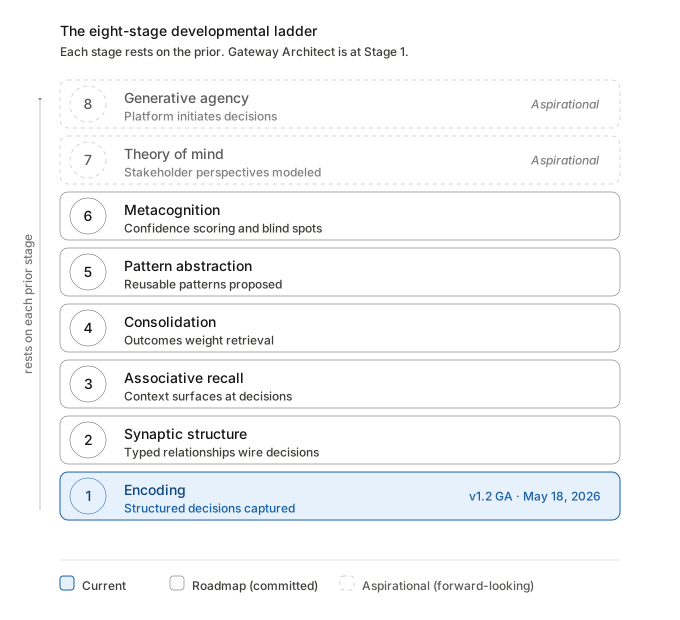
4.1 Stage 1: Encoding
Decisions are captured as structured records. Memory traces are laid down. The closed loop (Discovery, Architectural Decision Record, generated code, pull request) is the act of recording.
Stage 1 is more demanding than it appears. Structured means each record carries explicit fields for context, alternatives considered, predicted consequences, approvers, and timestamps, with the structure enforced by the capture flow rather than suggested by a template. The failure mode at Stage 1 is a free-text Architectural Decision Record repository where the structure is offered but not required. Author intent without format constraint produces records that look like ADRs but cannot be queried as decisions, because the fields are present in some records and missing or inconsistent in others.
The buyer test for Stage 1 is whether the platform refuses to accept a decision record without rationale. A platform that allows an architect to commit a decision without recording why has not crossed the Stage 1 threshold. Gateway Architect’s v1.2 Closed Loop GA enforces the rationale field at capture; the system will not accept a decision record without it. Stage 1 is also the floor of the category. A product that does not reliably encode structured decisions cannot claim to be an Organizational Memory Platform regardless of what else it offers.
4.2 Stage 2: Synaptic structure
Decisions are wired together with typed relationships: supersedes, requires, constrains, contradicts, extends, implements, related-to. A decision in isolation is data. A decision with synapses is knowledge.
The relationship layer is the substrate for everything that follows. Without typed relationships, a corpus of captured decisions remains a flat list of records that can be searched but cannot be reasoned over. Typed relationships make it possible for the platform to know that decision A supersedes decision B (so B’s outcomes inform A’s confidence but no longer carry current authority) and that decision C contradicts decision A (so the conflict can be surfaced for resolution rather than buried in two records that nobody links).
The buyer test for Stage 2 is whether the platform models a graph of typed relationships or only a flat structure with tags. Tags support filtering. They do not support reasoning. A platform that exposes related-to as the only relationship type has not crossed the Stage 2 threshold, because reasoning requires the platform to know what kind of relationship two decisions have, not only that some relationship exists. Stage 2 is the hardest stage to skip on the way to higher stages, because every subsequent stage depends on the relationship graph being typed. Gateway Architect crossed the Stage 2 threshold with v1.3 Synaptic Structure, shipped June 2, 2026: a closed grammar of seven typed relationships (supersedes, requires, constrains, contradicts, extends, implements, related-to), append-only retirement with full audit, a contradiction-resolution workflow, and a typed decision graph. With v1.4, the typed-relationship graph can extend across projects when an owner grants a share, governed by the organization’s Relationship Scope setting; the default keeps the graph scoped to the owning project.
4.3 Stage 3: Associative recall
Relevant context surfaces at the moment new decisions are being made, not after. The platform exposes this recall layer through an interface that any decision-forming process in the organization can consume: code generators, project planning tools, and AI assistants elsewhere in the engineering stack.
Concretely, this is an API that returns the relevant prior decisions for a given context query, scoped to the customer’s tenant boundary and to the caller’s zero-trust visibility. At Stage 3 the Organizational Memory Platform functions as infrastructure under other tools, not only as a destination application. This is the first stage at which the platform’s value is visible to people who never open the platform’s own interface. Gateway Architect crossed the Stage 3 threshold with v1.4 Associative Recall, shipped July 2, 2026: a REST Architecture Context API at /api/context/ with four operations (search, single-decision fetch, scope constraints, and a primary relevance bundle), and a Model Context Protocol server at /api/mcp. That MCP surface shipped with six tools and exposes twelve as of v1.4.9. Seven read: search_semantic ranks by meaning, so it finds decisions whose titles share none of the query’s words; search_decisions matches a title substring; relevant_context, get_decision_with_relationships and get_constraints_for_scope return the neighborhood, one decision in full, and the rails a change has to respect; and get_corpus_ledger returns the decision ledger; and get_server_info is a diagnostic, reporting the live version and the revision of the tool list the calling client is holding. Five write: record_outcome records what happened when a decision was applied, so the platform learns what the agent did with each one; record_observation records a measured fact that claims no authority; and capture_decision, update_decision and relate_decisions author and connect decisions. Those last three reach only a browser-authorized connection, never a service token, because a service token identifies an application rather than a person. No tool can approve a decision: a captured decision always arrives awaiting review. Configured once, coding agents in Claude Code, Cursor, GitHub Copilot, and ChatGPT and Codex ground their suggestions in what the team actually decided. Every response is gated by the organization’s zero-trust visibility and authenticated by a per-organization API token.
The buyer test for Stage 3 is whether recall is exposed as an API or only as a user interface. UI-only recall is a destination product; recall exposed as an API is infrastructure. The distinction matters because tooling diversity in modern engineering organizations means that no single destination application captures the moments when architectural decisions are actually being formed. Decisions form in code editors, in pull request reviews, in design documents, in chat threads, in planning sessions. A platform that requires the architect to leave one of those contexts and visit the platform to retrieve prior reasoning has solved a smaller problem than the one the category exists to solve. Gateway Architect exposes recall as both an API and an MCP server, and meets its own Stage 3 buyer test as of v1.4.
The v1.4 release also introduced the organization decision graph, a cross-project synaptic view that makes team-boundary-crossing architecture visible while respecting the same zero-trust rules described in Section 5.2.
4.4 Stage 4: Consolidation
Decisions are tagged with implementation outcomes. The corpus stops being uniformly weighted. Validated decisions carry stronger signal than abandoned ones.
The mechanics of consolidation are specific. Outcomes flow into the platform from multiple sources: pull request status against the originating decision, deployment outcomes from infrastructure tooling, post-implementation feedback from the engineers who lived with the decision, and incident reports tagged back to the decisions that produced the affected systems. The platform needs a structured outcome model that survives the operational life of the decision, not a free-text comment thread.
The buyer test for Stage 4 is whether outcomes are explicitly modeled and weighted, or recorded as free-text comments. Free-text comments do not consolidate; structured outcome tags do. Gateway Architect has shipped Stages 1 through 3, and its implementation-feedback system is capturing the outcome signal now. Stage 4 begins with v1.4: candidate retrieval still selects decisions by similarity, but the ranking of what is retrieved now reflects outcomes. Validated decisions are boosted, decisions the team abandoned or flagged for revision are penalized, and decisions sitting on unresolved critical feedback are downweighted, with the outcome adjustment surfaced alongside similarity so a caller can see why a decision was returned. Full Stage 4, in which outcomes are weighted into retrieval itself and not only the ranking of retrieved candidates, remains near-term roadmap.
4.5 Stage 5: Pattern abstraction
Semantic memory layers on episodic memory. The platform stops only recording individual decisions and starts proposing reusable patterns. The pattern claim is specific and bounded: nine teams in this organization solved authentication this way, with these outcomes. Not nine teams across all customers; nine teams within this single organization’s tenant.
The mechanics matter. The platform clusters semantically similar decisions across teams within the tenant boundary, and proposes patterns when a cluster exceeds a confidence threshold derived from cluster size, outcome consistency, and recency. The proposed pattern is reviewed and approved by an organizational architect before it becomes a retrievable pattern in the corpus. Without the human review gate, pattern proposals degrade into noise because the threshold can never be tight enough to be both sensitive (catch real patterns) and specific (reject false ones) at machine accuracy.
The buyer test for Stage 5 is twofold. First, whether patterns are tenant-bounded; cross-tenant pattern claims fail the data isolation guarantee that the category requires in regulated environments. Second, whether patterns are human-reviewed before retrieval; unreviewed patterns produce the superstitious-retrieval failure Walsh and Ungson warned about, automated at machine speed and scale. BrainDrop™ is Gateway Architect’s pattern-clustering technology, designed to power the eventual Stage 5 layer of the product. By design, BrainDrop will operate within tenant boundaries and will require architect approval before any proposed pattern enters the retrievable corpus. Full Stage 5 ships only after the structural foundation of Stages 3 and 4 is in place.
4.6 Stage 6: Metacognition
The platform models what the organization knows and what it does not know.
Confidence scoring is the concrete mechanism. A pattern proposed at Stage 5 carries a confidence score derived from the size of the cluster, the consistency of outcomes across cluster members, and the recency of the underlying decisions. At Stage 6, the platform exposes the confidence score to the user and explicitly signals when confidence is low (this pattern is based on three decisions, two of which had mixed outcomes). Blind spot identification works in reverse: when a decision-forming context has no relevant cluster in the corpus, the platform says so rather than fabricating a pattern from insufficient signal. The platform can flag a decision-forming moment as one in which the organization has no prior reasoning and surface external references (open-source projects, academic research, published post-mortems) instead.
The buyer test for Stage 6 is whether the platform admits ignorance. A platform that always produces a confident-sounding response to a retrieval query has not crossed the Stage 6 threshold, because confident-sounding responses to insufficient signal are precisely the failure mode that produces superstitious automatic retrieval. Stage 6 is the stage at which the platform begins to govern its own retrieval rather than acting as a passive index. It is also the stage at which Walsh and Ungson’s warning about superstitious behavior can be addressed structurally rather than left as a category-wide failure mode that buyers must manage manually.
4.7 Stage 7: Theory of mind (aspirational)
The platform models the perspectives of different stakeholders within the organization: the CTO, the compliance officer, the platform team, the security team, the procurement function.
In practice, Stage 7 produces predictions of cross-role response before a decision is finalized. When an architect is forming a decision, the platform predicts how the compliance officer would respond (this decision conflicts with the data residency policy adopted in Q2), how the security team would respond (this introduces a third-party dependency that has not been threat-modeled in the prior architectural decisions), and how the platform team would respond (this conflicts with the service mesh strategy adopted six months ago and not yet superseded). Theory of mind requires the platform to model both the organizational structure and the prior decision history attached to each stakeholder role.
Stage 7 is structurally dependent on Stage 6’s metacognition layer, which is itself dependent on Stage 5’s pattern abstraction. Building Stage 7 without the lower stack produces a system that pattern-matches stakeholder roles to language but cannot anchor its predictions in actual organizational history, which is not theory of mind but rather stereotype generation. Stage 7 is targeted in the second-year roadmap. Readers evaluating Gateway Architect for procurement should treat Stage 7 as forward-looking and not yet shipped.
4.8 Stage 8: Generative agency (aspirational)
The platform initiates decisions rather than only supporting them.
Platform-initiated decision-making is bounded. The platform monitors the corpus for conditions that warrant a new decision: a prior decision whose implementation outcome has drifted from its predicted consequences, an external compliance change that conflicts with a previously approved architectural posture, a pattern that has recurred across enough teams to warrant explicit standardization rather than ad-hoc repetition. When the platform identifies a warranting condition, it drafts an Architectural Decision Record and submits it for human review. The architect’s role at Stage 8 is editorial rather than originating, but the final authority remains human.
Generative agency is the terminal stage of the developmental model. The structural dependencies of the prior seven stages make Stage 8 a meaningful endpoint rather than a feature to be shipped early. Premature implementation of Stage 8 without the structural foundation of Stages 1 through 7 produces an automated decision-making system that cannot explain its proposals, cannot anchor them in organizational history, and cannot calibrate its own confidence. That is not generative agency; it is generative confidence, which is worse than no system at all because it produces plausible-sounding decisions that have no defensible reasoning underneath them. The honest forward-looking statement is that Stage 8 is the long-horizon endpoint of the developmental ladder, not a near-term roadmap item.
4.9 Why the ladder matters
The compounding property is structural. Stage 3 (recall) is meaningless without Stage 2 (synapses). Stage 5 (patterns) is impossible without Stage 4 (consolidated outcomes). Stage 6 (metacognition) requires the full lower stack. Competitors approaching the category from adjacent positions arrive at Stage 1 and must traverse the same dependencies in the same order. Acquirers cannot merge two organizational corpora the way they can merge two feature sets, because what is being merged is not a feature surface but a history of decisions and outcomes specific to the organization that produced it.
The ladder also serves a practical purpose for procurement evaluation. Buyers can use the eight stages to test vendor claims. A vendor claiming to be an Organizational Memory Platform should be able to point to specific capabilities at each stage they claim to operate at, including the structural mechanisms (typed relationships, structured outcome tagging, confidence scoring, tenant-bounded pattern clustering) that distinguish each stage from a marketing assertion about it. A vendor that cannot demonstrate the mechanism at a given stage has not crossed that stage’s threshold, regardless of the language used in the sales conversation.
Finally, the ladder explains why current Architectural Decision Record repository tooling, which is the closest adjacent category to a Stage 1 Organizational Memory Platform, does not satisfy the category definition. ADR tools sit at the floor of Stage 1 without the synaptic structure that Stage 2 requires. The transition from Stage 1 to Stage 2 is the transition from a collection of records to an organizational memory. That transition is where most adjacent tools stop and where the Organizational Memory Platform category begins.
5. The Data Isolation Guarantee
An Organizational Memory Platform is, by definition, an instrument of organizational learning. It is not an instrument of industry learning, vendor learning, or cross-customer aggregation. The customer organization, alone, owns what its memory contains. Three commitments govern how customer data is handled. They hold together; none is meaningful without the others.
The figure below summarizes the data flow boundaries.
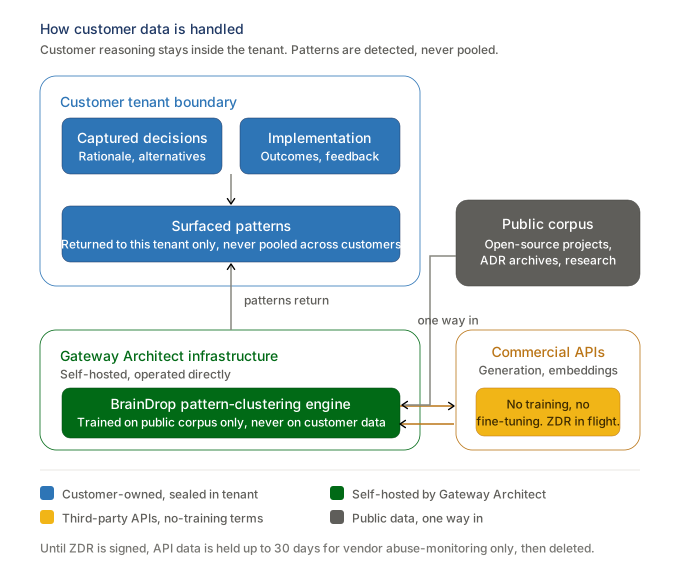
1. No cross-customer data pooling, ever. Captured decisions, outcomes, patterns, and surfaced recommendations are processed exclusively within the customer’s tenant boundary. There is no anonymized aggregation across customers, no industry benchmark built from customer data, and no opt-in pooling tier. Each customer’s BrainDrop corpus is sealed within their tenant. Where peer comparison is useful, the platform draws on public open-source projects, public decision archives, academic research, and published post-mortems. The public corpus travels inward. Customer decisions never travel outward. This commitment is contractually binding from contract signature.
2. The proprietary pattern-clustering engine is self-hosted. BrainDrop, Gateway Architect’s pattern-detection engine and the source of the compounding-memory moat, runs on infrastructure Gateway Architect operates directly. Its clustering model is trained on the public corpus and Gateway Architect’s internal data only, never on customer data. Customer reasoning processed through BrainDrop does not reach third-party model infrastructure. BrainDrop is the subject of provisional patent application US 63/916,445, with a non-provisional filing deadline of November 13, 2026.
3. Generation and embeddings use commercial enterprise APIs under strict terms. Architectural-decision drafting and code generation use a commercial enterprise model API. Semantic embeddings use a commercial enterprise embeddings API. These are two distinct vendor relationships with two distinct contractual surfaces. Under both vendors’ standard enterprise terms, customer data is never used to train their models, and Gateway Architect is not enrolled in either vendor’s data-sharing or fine-tuning program. Zero Data Retention agreements with both vendors are in active negotiation and are expected to be in place ahead of the first Defense design partner go-live. Until those agreements are signed, data passed to these APIs is retained up to thirty days for the vendors’ abuse-monitoring purposes only and is then deleted. Gateway Architect retains no copies, performs no aggregation, and participates in no data-sharing or fine-tuning program.
This is the honest current state: self-hosted where the moat lives, commercial enterprise APIs under standard terms where industry-leading model quality lives, and no customer data used to train any model anywhere. When Zero Data Retention is signed, this document will be updated to reflect that. When it is not, the document will continue to say so. Customers in regulated verticals who require contractual Zero Data Retention before signing will have it in place before they need it.
5.1 Security architecture
Tenant isolation is enforced at the database layer. Row-level security policies enforce tenant and resource boundaries inside the database, so a query that should not return another organization’s data does not return it regardless of how the request was formed. Every application route is additionally covered by an automated cross-organization isolation check that runs on every build, making continuous-integration enforcement of tenant isolation an invariant of the codebase.
Authorization is centralized and least-privilege. Role and membership checks resolve through a shared set of stable, security-reviewed database functions. Access is granted explicitly; absence of a grant denies the action.
Decision durability is governed. Architectural decisions, implementation feedback, and projects carry a full lifecycle. Active, archived, deleted, and legal-hold states are explicit and auditable, each with actor, timestamp, and reason. A decision under legal hold cannot be removed regardless of retention policy. At end of retention, decision records and their lineage edges are purged together so the corpus does not carry phantom references to retired decisions. This is a deliberate data governance commitment, ensuring the organization’s memory persists as an auditable record across its full lifecycle. Customers with regulatory or contractual retention requirements beyond the default policy can configure those requirements at the tenant level.
Administrative access is scoped, time-limited, and fully accountable. Administrative impersonation, where used for support, runs under a separate elevated session distinct from the administrator’s normal session, expires automatically, displays a persistent indicator while active, and writes an immutable, reason-required entry to the administrative audit trail for every action. Every privileged administrative action is logged with actor, target, reason, and source.
5.2 Zero-trust visibility across projects
Within a customer organization, every project’s decisions are private by default. A caller sees a decision only if they are a member of that decision’s project, or a member of a project that has been granted an explicit share into it by the owning project. Sharing is a deliberate, owner-granted act: it is audit-tracked, revocable with a captured reason, and never widens visibility beyond what an owner has granted. An organization-wide setting governs whether the relationship engine considers only a decision’s own project (the default) or also the projects that have shared into it.
The same visibility rule is enforced on every surface: the browser interface, the REST Architecture Context API, the MCP tools, and the organization decision graph. There is no surface on which an external token can see more than a member of the browser interface would. Cross-organization sharing is prohibited at the database layer, not merely discouraged in the application. This is the intra-organization counterpart to the cross-customer seal set out in the three commitments that open this section: memory is shared only where an owner inside the organization has chosen to share it, and never across organizations.
External access is authenticated by per-organization API tokens that only administrators can issue. Tokens are stored hashed at rest, carry an oga_ prefix so they are caught by standard secret-scanning, are rate-limited per token, and are automatically revoked if the issuing member loses their membership. Token issuance, revocation, and use are logged.
5.3 Security roadmap
Gateway Architect is candid about the difference between a strong foundation and a fully matured enterprise governance surface. The following work is committed ahead of the regulated-vertical design-partner program, where a Defense or financial-services security review will expect it:
- Hashing of administrative invitation tokens at rest.
- Multi-factor re-verification at the moment an administrator initiates impersonation.
- An expanded database-layer negative-path test suite that asserts isolation directly against the data store, complementing the existing route-level coverage.
Beyond that near-term hardening, the category-maturity path includes centralized policy governance with explicit deny and restriction precedence, inheritance-aware permissions across the organizational hierarchy, and time-validity windows on governed entities. These are roadmap items that extend the platform’s existing governance model toward fuller maturity in line with category evolution.
6. Strategic Implications and Vertical Roadmap
6.1 For buyers
Organizations that have been trying to solve their institutional knowledge problem with general-purpose knowledge management, learning management, GRC tooling, enterprise search, or general-purpose AI chat have been buying tools that address one or two of the Walsh-Ungson retention bins partially. The cost of forgetting has continued to rise because the underlying problem was never the category they were buying. The Organizational Memory Platform category names the problem correctly and addresses it as a system rather than as a content store. For buyers in regulated industries, the data isolation guarantee in Section 5 is the unlock that adjacent categories cannot match.
The buyer profile is consistent across the verticals Gateway Architect has prioritized. The architect, the program technical lead, the chief technology officer, and the chief information security officer share a common need: a system of record for the reasoning behind architectural and operational decisions, with implementation outcomes linked and surfaced at the moment of relevant new decisions. The compliance and tagging overlay differs across verticals; the buyer profile does not.
6.2 For the market
New categories of enterprise software establish themselves through demonstrated outcomes rather than through positioning alone. The Organizational Memory Platform category becomes real to the extent that products built explicitly against it deliver measurable results that products built for adjacent categories cannot. Gateway Architect’s near-term focus is to demonstrate this in the software architecture vertical, then to extend the pattern outward into adjacent domains as the platform matures. The category language is the framing that makes the difference legible to enterprise buyers, procurement teams, and analysts. The substance underneath the language is the product, the developmental ladder, and the data isolation architecture described in the prior sections.
6.3 The vertical roadmap
Across the regulated verticals below, the relevant certifications (SOC 2 Type II for commercial regulated buyers, CMMC and the FedRAMP trajectory for Defense, FFIEC and DORA for financial services) will be timed to design-partner requirements, with the security architecture designed against those frameworks from the foundation. The compliance overlay changes by vertical; the buyer profile and the product do not.
Software architecture (committed, currently shipping). Gateway Architect v1.2 Closed Loop GA shipped May 18, 2026, followed by v1.3 Synaptic Structure on June 2, 2026, and v1.4 Associative Recall on July 2, 2026, advancing the platform to Stage 3 of the ladder. The closed loop runs end-to-end inside the product: Discovery, Architectural Decision Record capture, AI-generated code from approved decisions, pull request on GitHub, implementation feedback, BrainDrop pattern clustering, and surfaced context at the next decision moment. The buyer is the chief architect or staff architect of an engineering organization at the level of complexity where institutional architectural memory has become a measurable cost.
Defense engineering teams (committed, Year 1). Defense Industrial Base contractors and federal civilian agencies with engineering arms. The compliance overlay is CMMC L2 and L3, ITAR, and a FedRAMP trajectory. The buyer profile is consistent with software architecture (chief architect, program technical lead) with the addition of the chief information security officer in the early procurement conversation. Cleared-personnel rotation is the operational driver: every contract cycle and every clearance rotation is an amnesia event, and Defense organizations feel the cost more acutely than most commercial engineering organizations.
Financial services engineering teams (committed, Year 1). Banks, asset managers, insurance carriers, and FinTech infrastructure providers. The compliance overlay is SOX, FFIEC, and DORA (mandatory in the EU since January 2025). DORA in particular has changed the audit posture in financial services; auditors now ask for evidence that architectural decisions were governed, not only that they were made. The Organizational Memory Platform category is structurally suited to producing that evidence.
Consulting practices (Year 2). Large engineering consultancies, both pure-play and Big Four advisory arms. The buyer is the practice lead. The product is the same. The differentiation is that consulting practices accumulate organizational memory across client engagements that they want to retain inside the practice rather than leave with the client, which creates a tenancy-and-permission model variation that the platform supports.
Adjacent domains (Year 2 and beyond). Legal partnerships, medical device regulators, and AI/ML governance teams are downstream domains likely to require Organizational Memory Platforms of their own. Different buyers, different domain primitives, but the same category logic. Gateway Architect’s role in those domains is to be the category-defining reference implementation rather than the only product in the category.
6.4 The design partner program
Gateway Architect’s design partner program for Defense and financial services engineering teams is open through the end of Q3 2026. Design partners receive early access, direct input into the platform roadmap, preferred pricing during the first commercial year, and contractual Zero Data Retention with both upstream API vendors in place ahead of go-live. Inquiries can be directed to paul@gatewayarchitect.com.
7. Conclusion
Walsh and Ungson gave the field a framework that has held up for thirty-five years. Kransdorff named the failure mode that the framework describes. The bins are still where memory lives, the processes are still how memory moves, and the failure modes both authors identified are still the failure modes organizations exhibit. What has changed is that the technology to do something about it has finally caught up to the theory, and the cost of not doing something about it has grown to the point of being measurable in trillions of dollars at the macroeconomic level and in lost institutional capability at the level of every individual enterprise.
Enterprise software has built every adjacent thing. It has built knowledge management. It has built learning management. It has built governance and compliance tooling. It has built enterprise search. It has built Architectural Decision Record tooling. It has built AI assistants that can read those artifacts and answer questions about them. What it has not built, until now, is a system whose primary purpose is to preserve organizational reasoning, link decisions across time, surface prior outcomes at the moment of present decisions, and do so under the governance constraints that enterprise buyers in regulated industries actually have.
The Organizational Memory Platform is the category that names and addresses this gap. The concept of organizational memory dates to Walsh and Ungson in 1991; the software category that productizes it was named in May 2026. Gateway Architect is the first platform built around its closed outcome loop, applied to software architecture, with Defense and financial services as the next committed verticals. The platform crossed Stage 3 of the developmental ladder on July 2, 2026, with v1.4 Associative Recall, exposing its memory as infrastructure that external AI tools consume directly, and continues to climb. Whether the category establishes itself will depend on whether products built explicitly against it deliver outcomes that adjacent products cannot. The work over the next several years is to demonstrate that empirically, beginning in software architecture and extending from there.
8. References and Disclosures
Primary references
- Forrester Research. Technology & Security Predictions 2025. Released October 22, 2024.
- Consortium for Information & Software Quality (CISQ). The Cost of Poor Software Quality in the US: A 2022 Report. Released November 2022. Co-sponsored by Synopsys (now Black Duck). Author: Herb Krasner.
- Accenture. Reinventing with a Digital Core. Released July 17, 2024. Based on a survey of 1,500 technology executives across 19 industries and 10 countries.
- Forrester Research. 2026 Technology & Security Predictions. Released October 28, 2025.
- US Bureau of Labor Statistics. Employee Tenure Summary, 2024 release (September 2024).
- Casanova, Carlos. Principal Analyst, Forrester. CFO Dive interview, November 2024.
Academic references
- Walsh, J. P., & Ungson, G. R. (1991). Organizational Memory. Academy of Management Review, 16(1), 57–91.
- Kransdorff, A. (1998). Corporate Amnesia: Keeping Know-How in the Company. Oxford: Butterworth-Heinemann.
- Levitt, B., & March, J. G. (1988). Organizational Learning. Annual Review of Sociology, 14, 319–340.
- Stein, E. W., & Zwass, V. (1995). Actualizing organizational memory with information systems. Information Systems Research, 6(2), 85–117.
- Olivera, F. (2000). Memory systems in organizations: An empirical investigation of mechanisms for knowledge collection, storage and access. Journal of Management Studies, 37(6), 811–832.
- Argote, L. (1999). Organizational Learning: Creating, Retaining, and Transferring Knowledge. Kluwer Academic Publishers.
Disclosures
Trademarks. Gateway Architect™, BrainDrop™, and Organizational Memory Platform™ are trademarks of Gateway Architect, LLC. Trademark applications are in active prosecution at the USPTO: GATEWAY ARCHITECT (Serial No. 99839852), ORGANIZATIONAL MEMORY PLATFORM (Serial No. 99839985), and BRAINDROP (Serial No. 99308890). All intellectual property is currently held by Gateway Architect, LLC, and the applications above remain of record to Gateway Architect, LLC. Assignment to Meryne, Inc., the holding entity, is in progress.
Patents. Provisional patent application US 63/916,445 covers core BrainDrop pattern detection methods; the non-provisional is in preparation, with a filing deadline of November 13, 2026.
Forward-looking statements. This document contains forward-looking statements regarding Gateway Architect’s vertical roadmap (Defense engineering teams committed for Year 1, financial services engineering teams committed for Year 1, consulting practices targeted for Year 2), Zero Data Retention agreement negotiations with upstream commercial API vendors, and Stages 7 and 8 of the developmental ladder. Forward-looking statements are aspirational, subject to change, and should not be treated as commitments without contractual basis. Procurement readers and analysts should verify current status before relying on any forward-looking claim.
Document status. This document is intended for enterprise buyers, procurement teams, analysts, partners, and prospective design partner program participants. It does not constitute an offer of securities, an offer to sell, or a solicitation of an offer to buy any equity interest in Gateway Architect, LLC or its successors.
Gateway Architect, LLC · Virginia · July 2026 · paul@gatewayarchitect.com
Get the PDF
Download the full whitepaper
Enter your email and your copy will download immediately. The full document is also readable in its entirety on this page.